
Professor Dictabeat·Guatemala→Berlin
Live electronic artist, DJ, producer, event manager
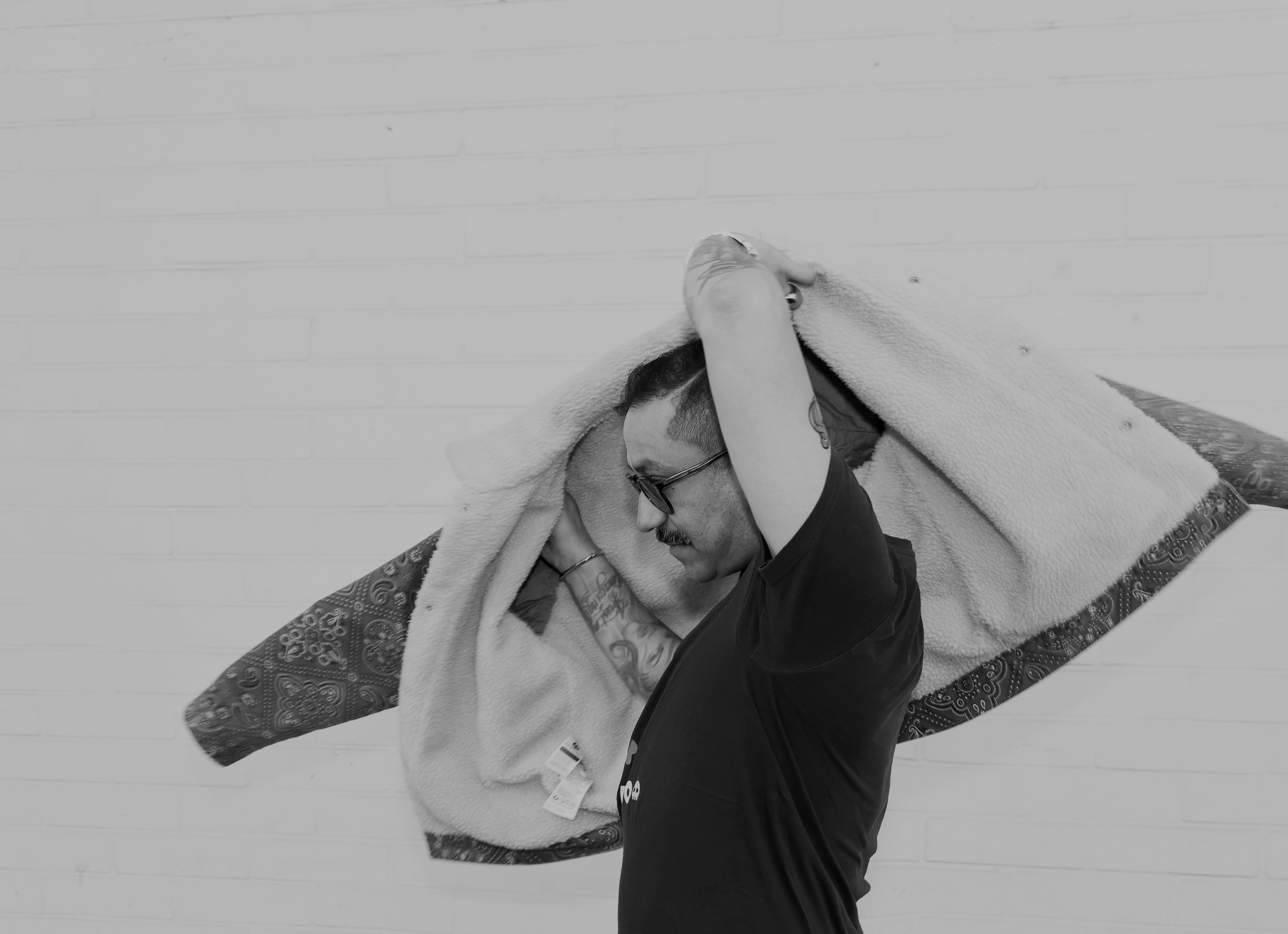

When he left Amsterdam in 2010, he made sure he could not come back. He quit the job. He broke up with his girlfriend. He cancelled the phone contract and cancelled the apartment, and then he told everyone he had ever worked with in the city that they were done.
"I told everybody in Amsterdam, listen, people, I'm moving to Berlin," he says. "I don't think I'll be back anytime soon. So whatever business we had is now concluded. And I wish everybody the best of luck. And I just left."
He was thirty, he had been DJing for eleven years, and he was leaving in order to stop. Amsterdam had turned him from a DJ into a promoter, and promoting had turned into a bi-weekly night and several others alongside it, until he was too burnt out to keep going. Berlin was meant to be the break. He would climb the corporate ladder instead. A friend had once brought him here for five days and they never went clubbing, so he arrived without much idea of what the city actually was.
Then somebody asked him to play at their bar. That turned into a second time, and a third.
"Before I knew it, I was back in the game."
Sixteen years on, he is on every side of the transaction at once, booking and promoting nights that he also plays. It means that when he explains where the money from an event actually ends up, he has stood in all three positions and watched it pass him.
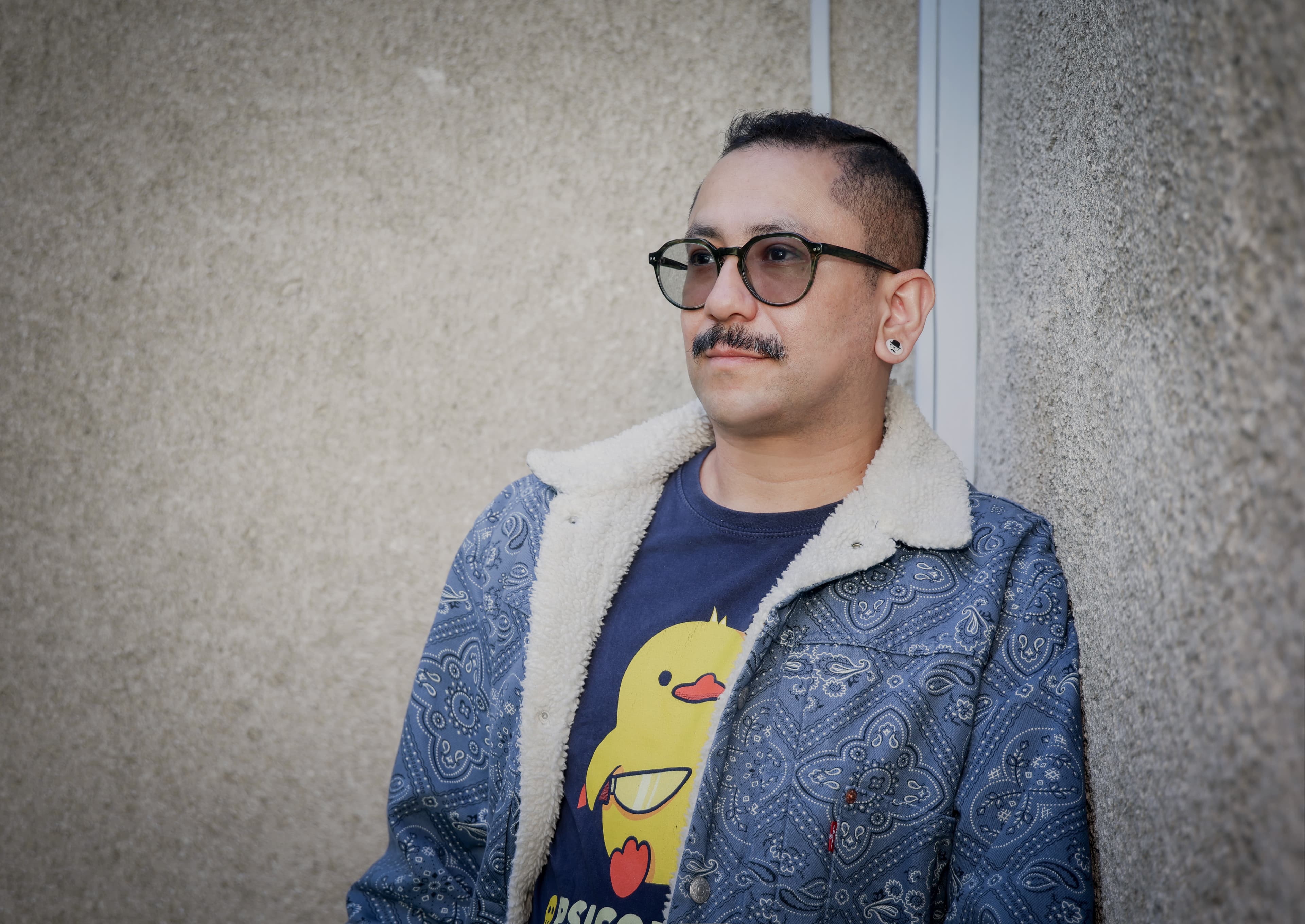

Everybody Is a Walking Light
Twenty-seven years after his first gig, he has made his first album. Everything before it was singles. Borrowed Light is out on E23 Records.
"This one was the first one where I said, okay, I want to do an album and share some things that are close to me."
The title holds the whole idea.
"I feel that everybody is a walking light," he says. "And sometimes you lend a bit, you borrow a bit of somebody else's light, you get inspired and you make something else."
Every track on it is about "a place, person or a pet or something that inspired me on my musical path, and that helped me become who I am." Ten songs, ten remixes, a different remixer for every track, pulled from all over the world. The remixes are being released separately and probably on vinyl, and the reason is a small argument about respect.
"Remixes, they deserve the attention that very often they don't get," he says. "So when you release something on vinyl, a DJ has something to spin." An album of remixes can be played in a club. A regular album mostly gets heard on a phone. His own tracks are danceable either way, but he wanted these ones to have somewhere to go.
Some of the album started at PLTFRM, which records DJ sets outdoors in industrial Berlin. He writes a custom set for every live performance, tailored to whoever is hosting, and the one he built for that afternoon stayed with him afterwards.
"I ended up liking that set so much that I took a few of those parts, and they actually became songs that ended up on my latest album."
What the Hell Is This
The first light he borrowed came from his grandmother. He was five. She walked in with a CD of Mozart and put it on the stereo.
"It just blew the doors wide open, and I said, what the hell is this."
He was born in Guatemala to a Nicaraguan father and a Salvadorian mother, and raised in Amsterdam from the age of two. His parents played almost nothing at home. Without that CD, he thinks the whole thing would have reached him years later.
After Mozart came everything else. Hip-hop in his teens, then drum and bass, rock, metal and pop, and eventually techno and electro, which is where he learned to DJ and where he stayed. Alongside all of it he played guitar, in death metal bands and hip-hop groups and pop groups. He was sixteen when a guitar teacher gave him the instruction that still runs underneath the way he works.
"Don't bother learning how to read notes. Learn to play by ear. Learn to listen to the people that you're playing with. Learn to listen to your environment, but also learn to listen to the music inside your head."
The CBGB of Amsterdam
He started DJing in 1999, at Vaaghuyzen, a cafe on the Nieuwe Nieuwstraat that had opened two years earlier with a booth, two turntables, and a dozen dance record shops within walking distance.
"It was one hell of a bar," he says. "Some of the most talented and amazing and impressive DJs came from that stable, as well as promoters. If anything happens in Amsterdam, it's because the people from Vaaghuyzen initiated something."
He calls it the CBGB of Amsterdam for electronic music, which is not much of a stretch. Steffi, Bart Skils and San Proper all came through it. It closed when the owner sold up and moved on.

As Little As Possible
The move into hardware started with a pregnancy. His band in Berlin split when the drummer got his girlfriend pregnant and left the city, and he was good enough that nobody could replace him.
"So the band just crashed and I decided to go explore."
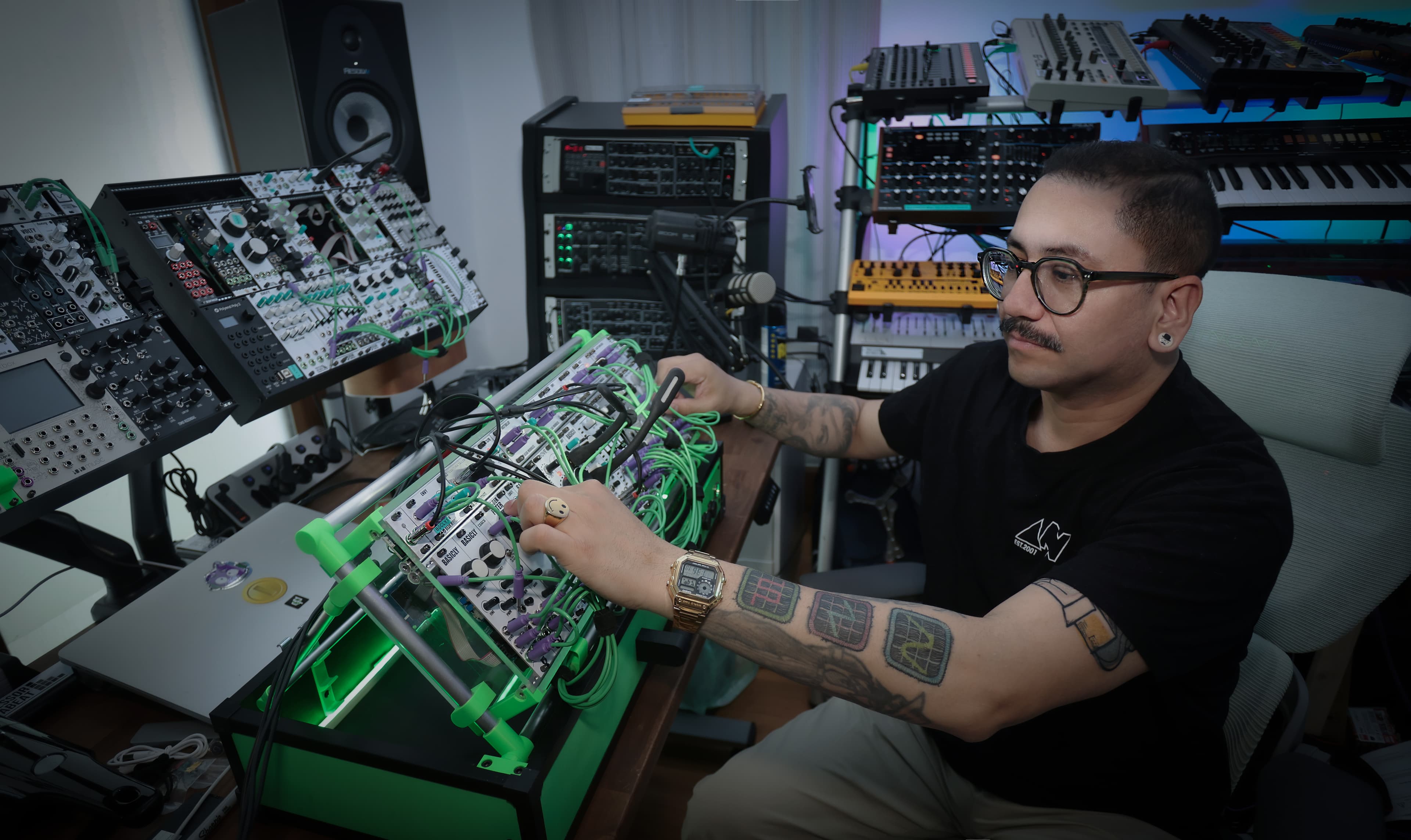
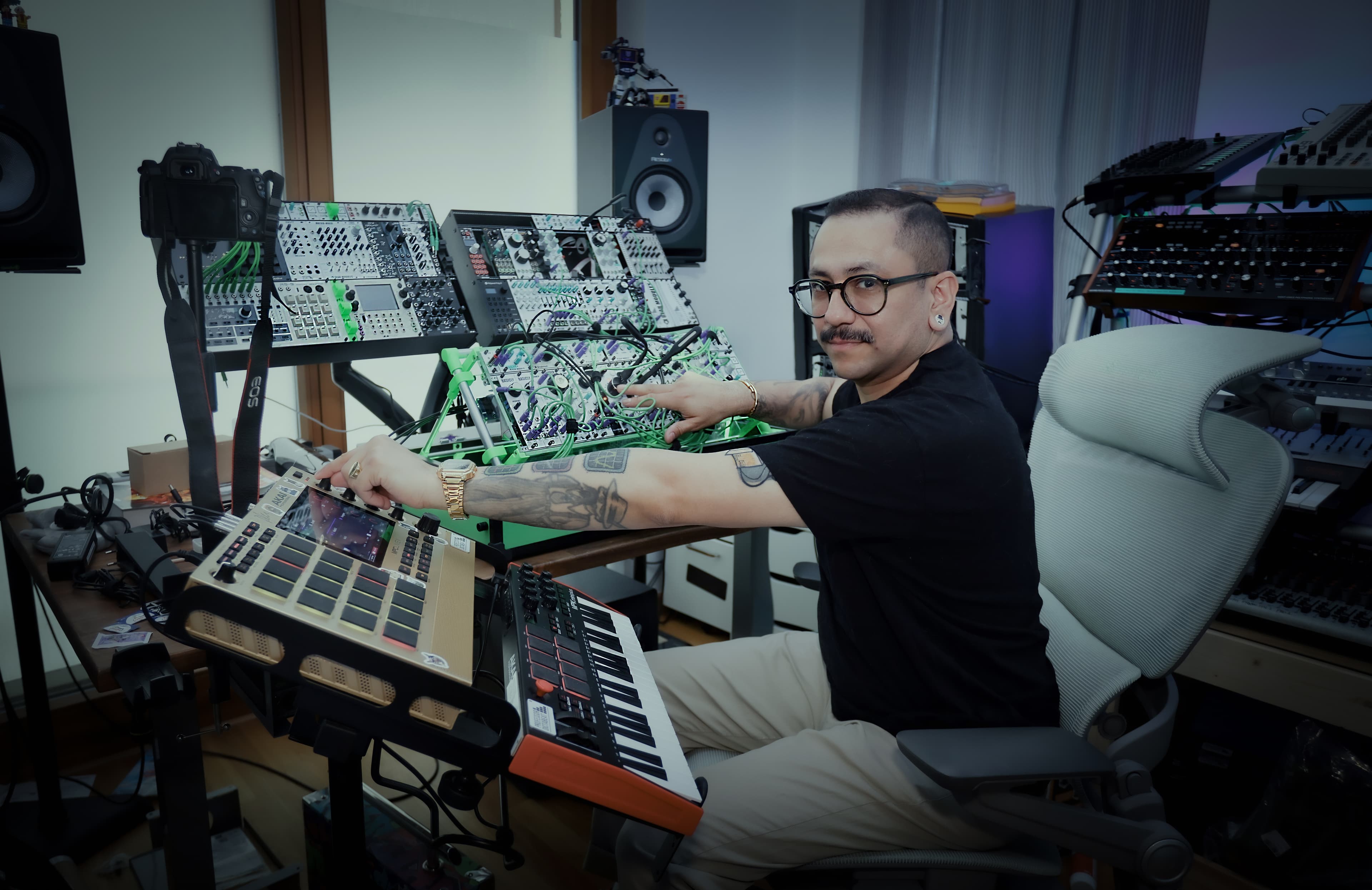
Hardware synthesizers landed on his doorstep in 2017. The MPC arrived in 2019, and only because he needed something to sequence the rest of the setup.
"They say all roads lead to Rome. Everybody kept referring me to the MPC, and eventually I gave in."
It is the foundation of everything now. He starts with a jam, comes back to old releases and builds new iterations out of them, and sometimes cuts a piece out of a fresh jam and grows a whole song around it. For a long time he had assumed those two halves of his life would stay separate, because it had genuinely never occurred to him that a DJ could also be a producer.
"The lights went on here and I said, you know what, I should make my own music and then play that music. It's really naive when you think about it."
His first live electronic show was in 2017, at 131, a bar on Chausseestraße in Mitte. Half of it ran on a drum machine and a synth, the other half was beats mixed on DJ gear, and all of it was too heavy to carry. There is a thirty second clip on Facebook that somebody shot on a phone, and once a year the site hands it back to him as a memory.
After that he started taking things off the table, and he has not stopped.
"A lot of artists, especially in the beginning, want to show that they are capable, and they bring as much gear as they can to fill the table, to look impressive," he says. "Whereas now I have the opposite, where I bring as little as possible and then try to get the most out of it, and show that I'm skilled in that way."
"Editing down is harder than expanding. You can always add more and clutter the sound. But it's a lot more of a task to edit down and get the most out of your stuff with a minimal amount of work."
The Groove Is Key
Ask him why a body starts moving when the music comes on and he goes back further than technique.
"For me it's a groove," he says. "I'm Latin American, I'm Hispanic, born in Guatemala. When you look at it from a historical perspective there's native Indian blood in there. And we connect spiritually to things. Groove and rhythms have always helped us connect to what I call our higher selves."
Baroque, African, Latin American or techno, the test does not change. "If there's a groove in it that sits well with you, it'll get you going. For me, the groove is key."

Forced to Do Something
When the clubs closed he could not play or perform or put on a single event, so he started streaming on Twitch. A friend who streamed video games told him to buy a webcam and an audio interface and get on with it, then showed him how.
What he found there was the Golden Shrimp Guild, the largest electronic live music collective on the platform, which runs telethon-style raids from stream to stream so that everybody playing gets watched by somebody. He regularly plays with the Golden Shrimp Guild and recently played its sixth anniversary. His Wednesday streams are his own, separate from the collective.
"I was always hopping into other streams and discovering some of the most amazing music. And people were discovering me."
“There's always an audience for your stuff, no matter how niche you are.”
— Professor DictabeatThe stream is also the thing that keeps him working. Once a week he has to make something whether he feels like it or not, and the point is deliberately not to make it good.
"In the beginning I really put a lot of pressure on myself to make only good songs and only hits, or only radio worthy material," he says. "And eventually I let go of that and I said no, I just want to jam, make music, and eventually if I do this often enough, like every week, I'll get good at making music on the fly."
Do it often enough and something sticks. That is where an album comes from.
Always Exploiting
He has spent long enough on both sides to split the industry into two things that get mistaken for each other.
"You have the music business, where promoters try to make money out of every commodity they can monetize," he says. "Or you have music culture, where people genuinely make music with the goal to contribute something beautiful to society."
Put it to him that culture seems to be losing while business grows, and he does not accept the framing.
"That's a lot of smoke and mirrors, because the music culture is always creating and the music business is always exploiting."
He describes the cycle without much bitterness. Anything that starts in a small circle finds its way up. Somebody realises an event can be made of it. The rich catch on and want a piece of the hip thing, it gets commoditized, it loses its soul, it fades, and the next hype arrives. Some hypes come round twice. There are techno events he would not be seen dead at, and techno events so small and so good he would pay double to get in.
If a young person told him they wanted into the music business, his first move would be to ask why.
"Is it because you want to make money? Is it because you love the music? Is it because you studied business in school?" If the answer is money, he is blunt about the arithmetic. "You're going to get cheated." The numbers do not work at small scale, and they only start working at the level where private equity has already put its head round the corner. Sell out a thousand tickets a month and you are doing well, and the club still takes more than you do, and so does the bar. "You're paying the artist last, because there's almost nothing left after you paid all the debt collectors."
He still runs events himself. In Amsterdam he held events at Westergas Terras, the space next to the Westergasfabriek where Awakenings is held, and they ran anywhere from 250 people to nearly two thousand. He used plenty of other venues too, and most of them are gone now. In Berlin he has stayed small. Neue Elektro Welle takes place every last Friday of the month at the Love Loft in Marienfelde. He does that one for the culture rather than the profit, for exactly the reasons above.
Booking, promoting and playing all at once has also shown him where the whole thing jams.
"One thing that many artists struggle with is to find booking agencies that are focused on their genre," he says. "Right now you just have to scrape the internet and look for everything, or talk to friends and reach people through word of mouth."
Where You Need to Be
Three weeks before we spoke, he went to a farewell for his friend DJ Eduardo Furia, one of the founders of the biggest Latin party in Amsterdam, a night that set off a whole run of Latin events across the Netherlands and eventually reached Germany. He was 53.
"He would always take requests, which is something that most DJs struggle with," he says. "But he would always take a minute to just shake your hand, look you in the eye, and make you feel human. Whether you were just a visitor, or a fellow DJ, or a fellow event manager. He didn't think bigger or smaller about anyone, and he treated everybody with such respect."
Going back to Amsterdam at all took work, because of how thoroughly he had cut the cords in 2010. By the time he returned the landscape had moved. The people he used to do business with had gone up a level, or left the industry, or died. Asked whether he would burn the bridges again knowing that, he does not hesitate.
"Everything that I've experienced so far has led me to where I need to be. I always tell people, you don't always get to go where you want, you get to go where you need to be."

Goosebumps
If the album is about light borrowed from other people, the obvious question is whether he gives any back. He is careful with that one.
There is a producer in Canada he looks up to, LeBlonde, who makes some of the best electro he has heard. LeBlonde told him one day that his single Rockstar is the blueprint he works from, his reference for what an electro track should sound like.
"I was dumbfounded by that compliment."
And in Amsterdam recently a woman stood in front of the booth holding her forearm up in front of his eyes. He could not work out what she was doing until she stroked her arm to show him the goosebumps.
"I feel that in that way everybody shares a bit of light," he says. "So I try to contribute good stuff. But in the end it's also not really up to me to say whether I'm giving light."

A Room With Nothing In It
The name started as a joke. In the Netherlands you are allowed to call yourself professor without holding a degree, and a friend, throwing DJ names around with him, pointed out that DJs are basically beat dictators.
"Beat dictators, Dictabeat. Professor Dictabeat. And then we had a good laugh about it."
Back then the joke had a point, because the DJ decided which records were going to matter and which were not. "Nowadays there's very different ways to make yourself famous." The name stuck anyway, and people now shorten it to Prof, and last month strangers in a crowd in Amsterdam recognised him by it.
"I feel at this point it's also too late to really switch names."
None of it, in his telling, started with talent. It started with his grandmother putting a CD on, and he thinks that what she switched on was already in him before she got there.
"If you want to figure out what music is in you, or if you have the music in you, try locking yourself in a room with nothing in it," he says. "Just for like 30 minutes. I guarantee you some music will come out of you."
Photography by Cristina Del Barco.